PCR: make more DNA.
Before you can detect anything, you usually need more of it.
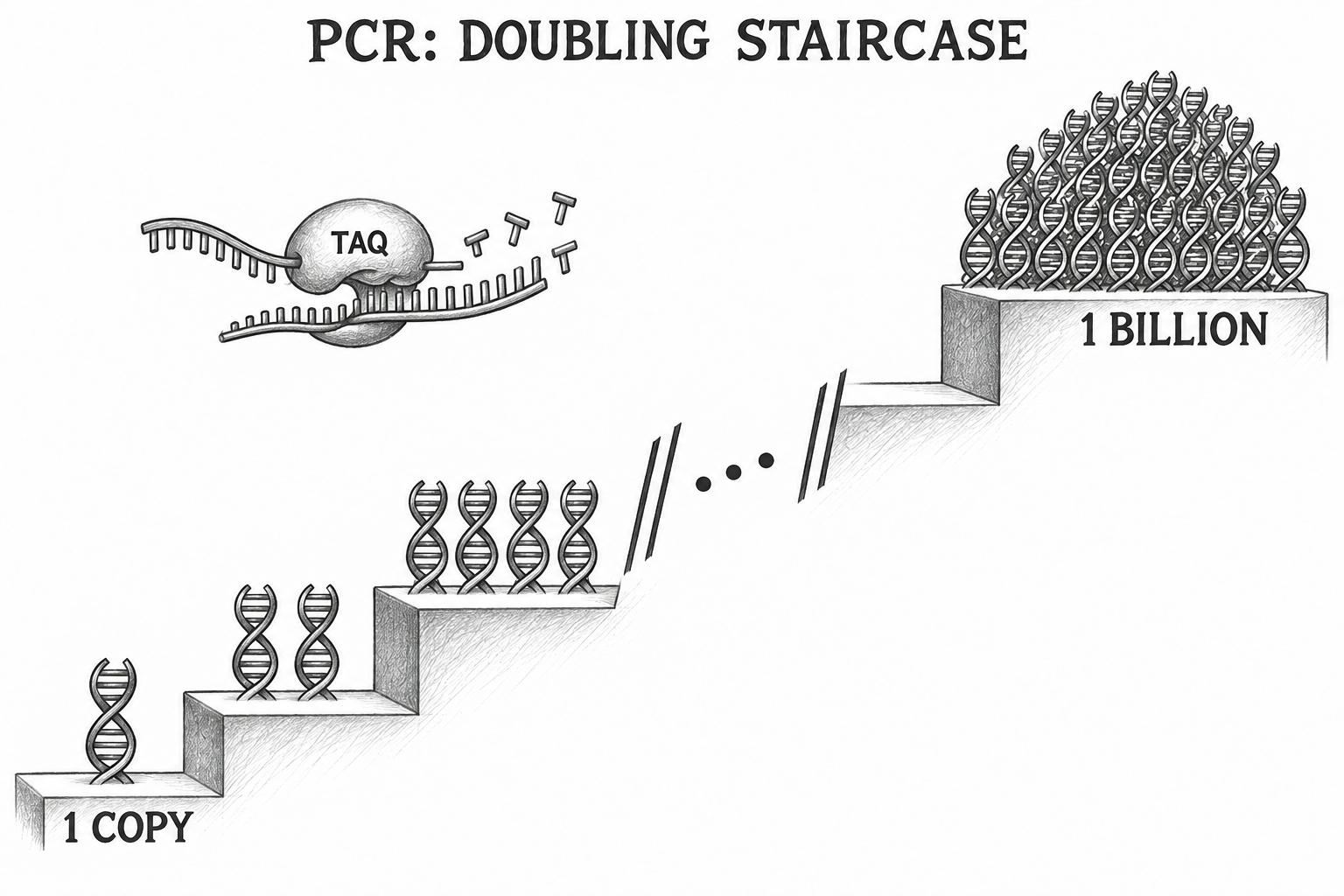
PCR—polymerase chain reaction—amplifies a chosen stretch of DNA. Two primers mark the target. Taq polymerase builds new strands. Repeat the cycle, and the number of copies grows.
Denature at about 95°C to separate the strands. Anneal at a primer-dependent temperature, often around 55°C, to let primers bind. Extend at about 72°C so Taq can synthesize the complementary strands.
Try the mechanism
Small doublings. Big numbers.
DNA copies after 10 cycles
Copies = 2cycles. This assumes 100% efficiency per cycle. Actual amplification is less efficient and eventually plateaus.
Why Taq? The repeated high-temperature step would inactivate a heat-sensitive polymerase. Taq is thermostable, so it can keep copying across cycles.
A common trap: within a comparable qPCR assay, a lower cycle threshold (Ct) generally means more starting template. The signal crossed the threshold sooner. Ct values are not directly interchangeable across assays.
Pause & recall
Why does PCR need a thermostable polymerase?
The denaturation step repeatedly heats the reaction to about 95°C. A heat-sensitive polymerase would lose activity; Taq survives these cycles and extends the DNA strands after primers bind.
Same idea. Different target.
Ask what you’re looking for before you name the test.
Southern, Northern, and Western blots separate molecules, transfer them to a membrane, and detect a target. The useful distinction is what that target is—and what binds to it.
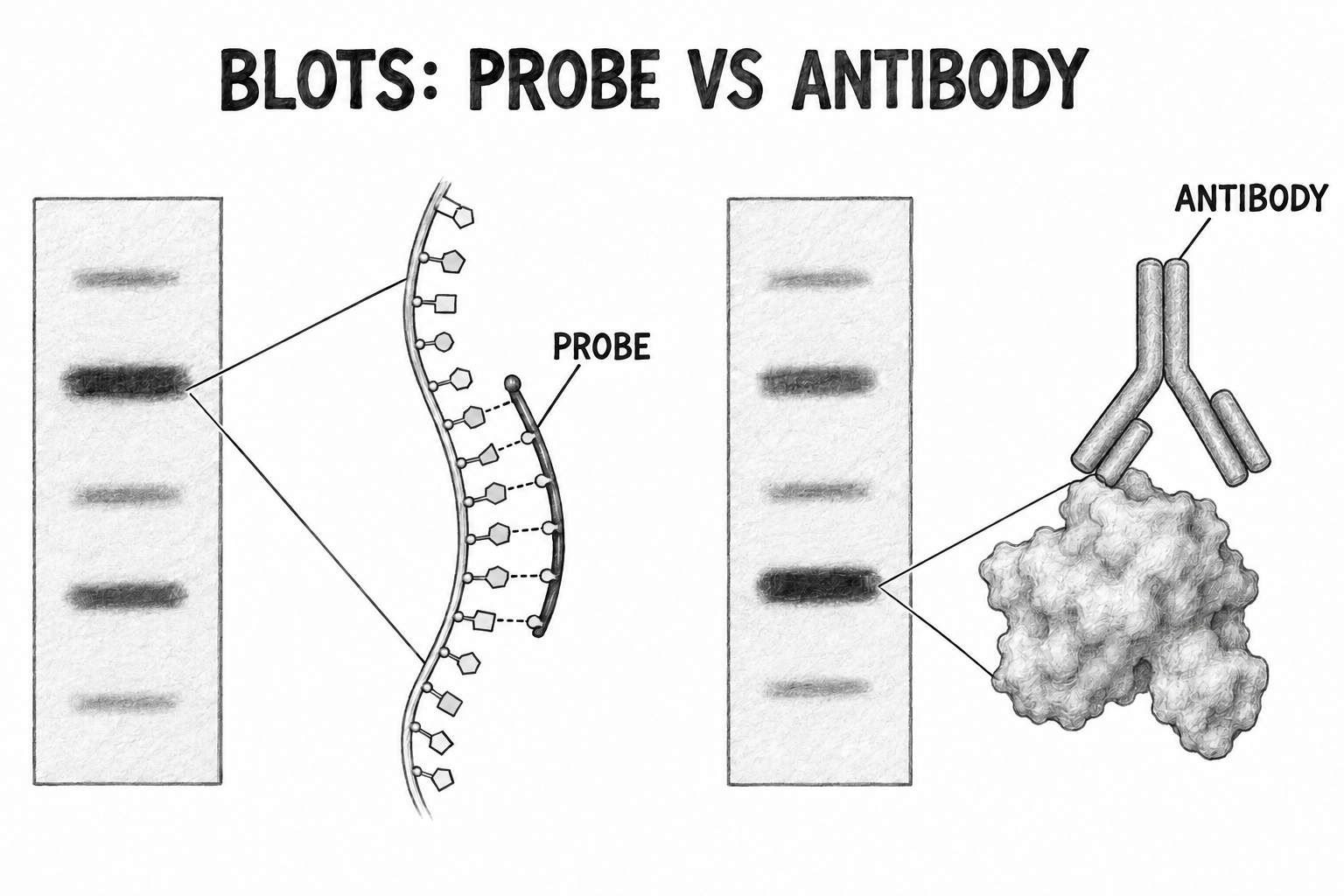
| Blot | Target | Detector |
|---|---|---|
| Southern | DNA | Nucleic-acid probe |
| Northern | RNA | Nucleic-acid probe |
| Western | Protein | Antibody |
Choose by the question
Detect a specific DNA sequence with a complementary nucleic-acid probe. Fragment size adds information.
A comparison of the techniques in this sample, not a clinical test-selection guide.
Pause & recall
A blot uses an antibody. What is its target?
A protein: this is a Western blot. Southern and Northern detect nucleic acids with complementary probes. The detector tells you which side of the DNA → RNA → protein sequence you are on.
A missing link tells the story.
PCR makes copies. Sequencing reads their letters.
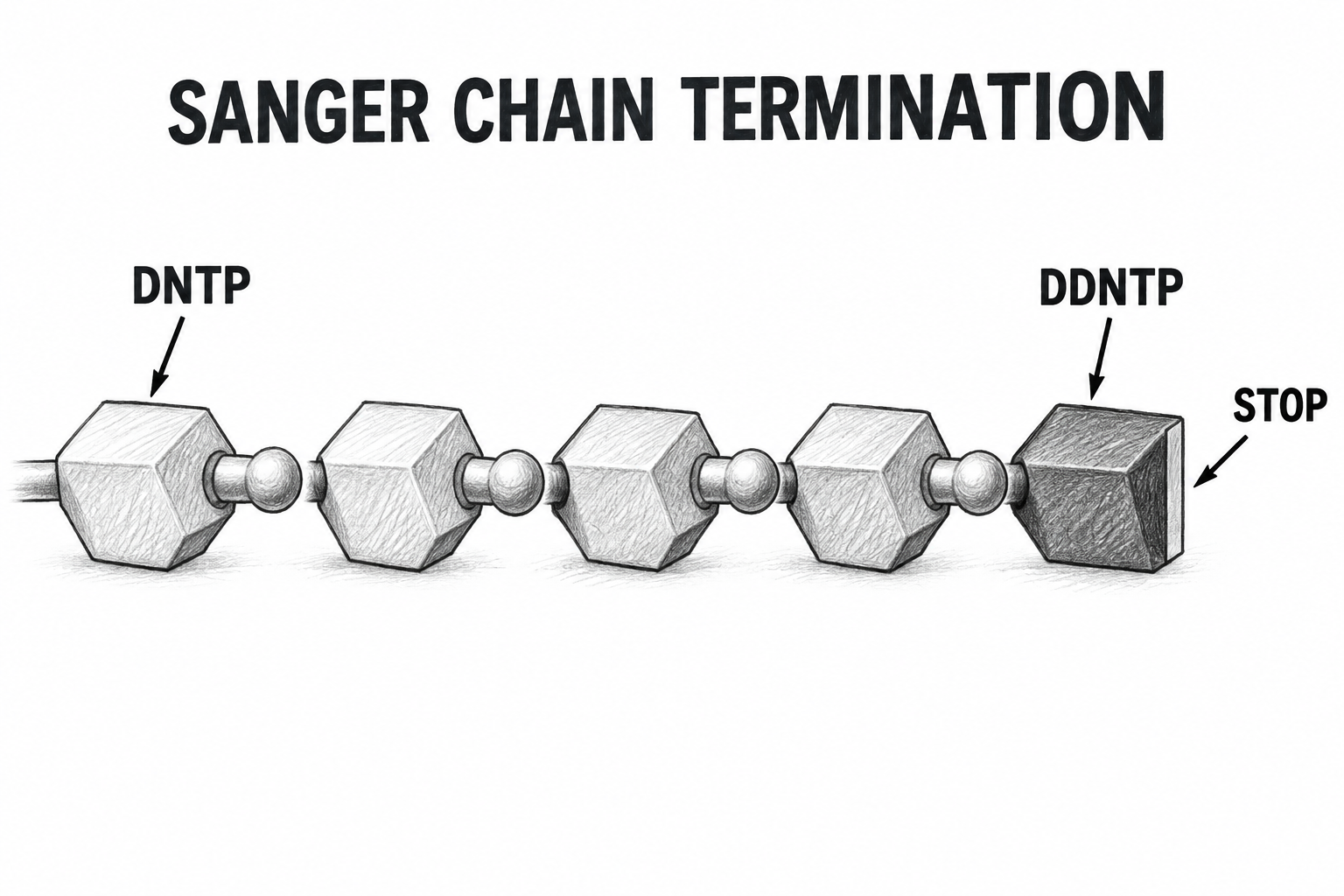
In Sanger sequencing, DNA polymerase builds a strand using ordinary dNTPs mixed with small amounts of chain-terminating ddNTPs. A ddNTP lacks the 3′ hydroxyl group needed to attach the next nucleotide. Once it is incorporated, that strand stops growing.
Across many copies, termination happens at different positions. Separating the fragments by size and detecting their terminal bases reveals the sequence.
Pause & recall
What makes a ddNTP stop the growing DNA strand?
It lacks the 3′-OH group required to form the next phosphodiester bond. The strand cannot extend after that nucleotide. Fragments ending at different positions allow the base sequence to be read.
About this sample & further reading
Adapted from selected passages in chapter 159, “Reading the Genome,” of The Companion, Revised edition. The full chapter also covers other molecular diagnostic tools. Three AI-generated illustrations were added for this sample; they are teaching metaphors, not laboratory data. Sample prepared September 15, 2026. Educational use, not patient-specific medical advice.
- NHGRI: Polymerase Chain Reaction Fact Sheet
- Thermo Fisher Scientific: Overview of Western Blotting
- NIST: Sanger Sequencing
The PCR counter is an idealized mathematical model. Recall answers stay on this page; this preview does not record study progress.